Clove Dental is India’s largest dental clinic chain with over 550 clinics and over 2.5 million patients. With so many patients and a high demand for clear aligners, Clove Dental requires scalable, high-throughput model production. Before the Form 4B stereolithography (SLA) 3D printer was released, Clove Dental produced 2,000 aligners a month. By February of 2026, they’d scaled to 10 Form 4B 3D printers, and increased throughput to 50,000 aligners per month.
But it wasn’t printer speed alone that enabled such dynamic results — custom print settings and a streamlined workflow powered aligner manufacturing.
Get in Touch
Whether you need to produce occlusal splints in-house, or are looking for high-throughput production of dental models, we’re here to help. Get in touch with a dental expert to find the right solution for your business.
High-Throughput Aligner Manufacturing
“Mass customization and high-speed manufacturing are requirements in the aligner industry and, with 20-30 aligners per patient, people had to figure out faster ways of doing it. So 3D printing became the norm. But there are still a lot of manual steps.”
Deepak Vadali, Head of Manufacturing & Distribution, Clove Dental
Clove Dental started production in February 2024 with Form 3B, switching to Form 4B a few months after its release in April of 2024.
“Immediately I bought Form 4B, plugged it in, and started producing the models. The go-to market is much faster now because of the machines getting nimble.”
Deepak Vadali, Head of Manufacturing & Distribution, Clove Dental

Clove Dental uses the Resin Pumping System to seamlessly deliver 5 L of resin through a pumping system directly to the printer’s resin tank.

Models for thermoforming aligners 3D printed on Form 4B in Fast Model Resin. Clove Dental uses the Flex Build Platform for easy and tool-free part removal.
Clove Dental uses Form 4B with Fast Model Resin to print models for clear aligners due to the speed, accuracy, reliability, streamlined workflows, and scalability. Highly accurate printing — at least 95% of the surface within 100 μm of the CAD model across the build platform — ensures a perfect fit, while 98.7% print reliability ensures fewer reprints, saving time and money.
Manual touchpoints are one bottleneck for high-throughput manufacturing. For printing, removing models from the build platform can be one of these bottlenecks. For this, Clove Dental uses Build Platform Flex, which easily removes parts in seconds and, Vadali says, “cuts down on our time significantly and enables scalability.”
Optimizing Printing and Printer Management
The first models for thermoforming that Clove Dental printed were in Fast Model Resin, Formlabs’ fastest printing resin, at 100 μm layer height. But, to achieve the desired throughput, the time per print batch needed to be shaved down.
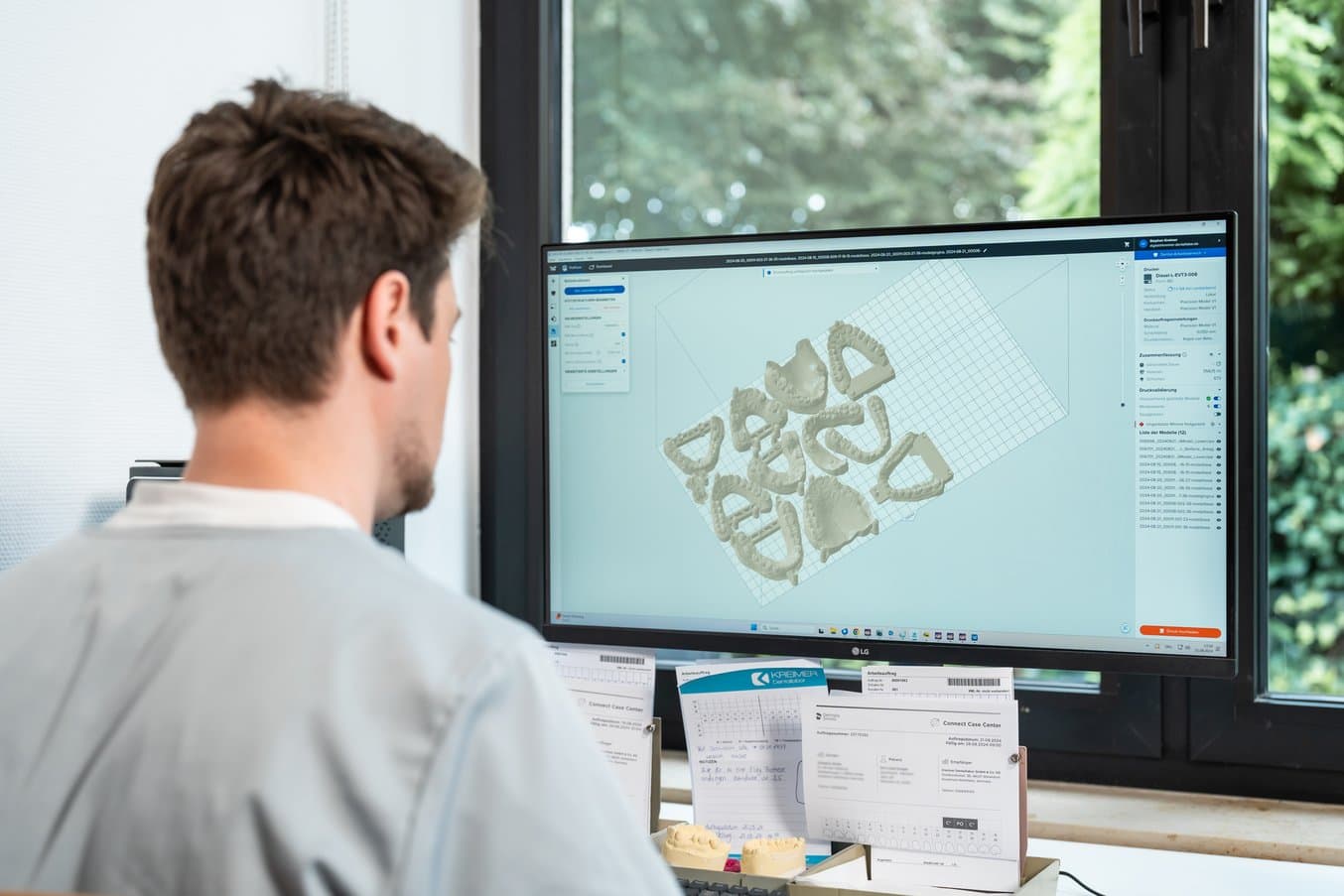
Clove Dental contacted Formlabs Dental experts to troubleshoot their timing problems. Formlabs Dental experts worked with Clove to design custom print profiles in Print Settings Editor, a PreForm Dental feature that enables expert users to tailor print performance, customizing a range of print settings, including:
-
Exposure time
-
Layer height
-
Resolution
-
Heating
-
Wiping
-
Interlayer motion
For expert users, these settings unlock the ability to customize workflows while maintaining the advanced material properties Formlabs resins are designed to offer. Users can also save custom print profiles, making it easy to apply them to future prints.

Custom profiles in PreForm Dental were developed to achieve the desired throughput while delivering the aesthetics and surface quality desired.
Dialing in custom profiles, Clove Dental arrived at a 120 μm layer height as one that achieved their desired throughput while maintaining aesthetics and surface quality.
Printing Models for Thermoforming in Fast Model Resin on Form 4B
| Number of models | Layer height | Time to print one build | Time for one model |
| 9 | 100 μm | 25-30 min | ~3 min |
| 9 | 120 μm | 15-20 min | ~2 min |
“120 microns gave us a good result and we were able to do fast printing with the cycle time and productivity we wanted.”
Deepak Vadali, Head of Manufacturing & Distribution, Clove Dental
In order to meet production demands while reducing operational costs, optimization and streamlined management are top of mind. To control all 10 Form 4B printers, Clove Dental uses Formlabs API developer portal to automate design-to-print workflows, saving time and touchpoints.
Clove Dental is using a honeycomb grid structure to reduce the weight of models and the amount of resin used. With this grid structure, they’ve achieved almost a 20% reduction on model weight.
With automation and 10 Form 4Bs, Clove Dental can manufacture up to 2,000 arches per shift.

A honeycomb grid structure is used to reduce both resin consumption and the weight of models.

Request a Free Sample Part
See and feel Formlabs quality firsthand. We’ll ship a free 3D printed sample part printed on the Form 4B to your office.
Manufacturing Workflow
Labor, regulatory compliance, and part tracking are some of the biggest challenges for high-volume production of patient-specific parts. Automation and digital integration have helped to decrease manual labor, as have the streamlined workflows for Formlabs 3D printers.
Vadali says, “The quality and accuracy of the print make life easier. We print a small code on the model that we detect with cameras.” This code enables model and product traceability throughout the process, with vision-based barcode and RFID tagging occurring after being roll-fed through the thermoformer so that clear aligners can be identified after laser marking and CNC cutting.
Once clear aligners are cut, they are manually polished and undergo a final quality control inspection before being sterilized in an ultrasonic bath, labeled, and packed.

Thermoformed aligners are manually polished before undergoing a quality control check.

After sterilization, aligners are labeled and packed.
Continuing to Scale: Increasing Throughput & Applications
In the next six months, Clove Dental will continue scaling aligner manufacturing, adding printers as well as automation to achieve their goals.
In addition to models for thermoforming, Clove Dental has added applications, using Precision Model Resin to print high-accuracy restorative models for crown manufacturing and IBT Flex Resin for printing indirect bonding trays. Indirect bonding trays enable the cementation of all brackets in 10-20 minutes, compared to the 40-60 minutes of individual bracket placement, saving orthodontists valuable chairtime.
With Print Settings Editor and API, Clove Dental is dialing in their workflows, increasing efficiency and scaling manufacturing.
Explore Form 4B or find a reseller to learn more. Request a free sample part to evaluate Formlabs materials for yourself.