

Built for Craftsmanship, Backed by Reliability: Nu-Art Dental’s Form 4B Story
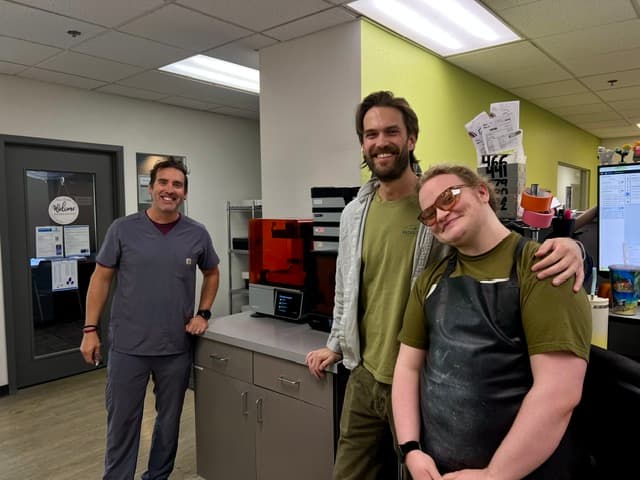
In the field of dental care, laboratory technicians sit in the intersection between science and art. Founded in 1977, Nu-Art Dental Lab has grown to a 70+ employee operation known for combining unmatched craftsmanship with state-of-the-art digital technology. Nu-Art has expanded an existing fleet of Carbon and Asiga printers by adding Formlabs Form 4B, an adoption that has granted them cost savings, more predictable results, and most importantly, more time for their technicians to do what they do best: put their signature on every restoration.
The Overlap of Art & Science
Nu-Art Dental Laboratory sits at an unusual intersection. Although most of their clients are local, with pickup and delivery, the Milwaukee based lab produces dental prostheses for clients across the United States, and on any given day a technician might be finishing a casting the way it would have been finished 50 years ago: one bench over from a rack of 3D printers. President Frank Haeuser sees that overlap as the point, not a transition phase.
"I'm really proud of being able to produce restorations the way they were done 50 years ago and being able to do them using the newest techniques."
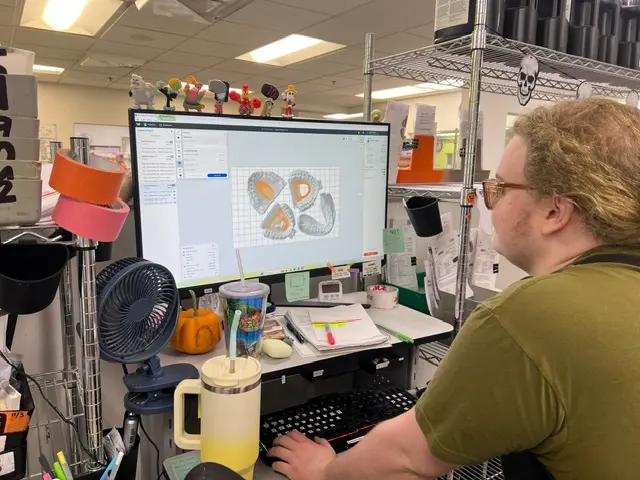
At 70 employees, Nu-Art is a mid-to-large lab, and Haeuser is direct about what separates it from labs of similar size: its people and services. "At the end of the day, every lab has access to great technology. Our difference is the experience behind it and the service we provide," he said. Walk through the lab and you'll see technicians coaching dentists through complex cases. Nu-Art has a prosthodontist on staff working cases directly, two dentists, and a third dentist supporting quality control, which is rare at any lab, and rarer at this size.
That’s also how Nu-Art approaches technology. “Technology gets us to the starting line. The artistry is how we make every restoration our own,” Haeuser said. For Nu-Art’s technicians, most of whom come from craftsman or artist backgrounds, 3D printing replaces the hours of hand waxing that used to come before any artistry could start. They begin with an accurate prototype and spend their time on “the frosting and the final finish,” the details that become Nu-Art’s signature.
Your Lab’s New Unfair Advantage
Relentlessly reliable, open dental 3D printing solutions with the best return on investment.
Why Formlabs Dental?
Haeuser met the Formlabs team at LMT Lab Day 2026. After learning Formlabs had a Milwaukee facility, minutes from his own, he visited to learn more about our 3D printing solutions.The visit changed his thinking.
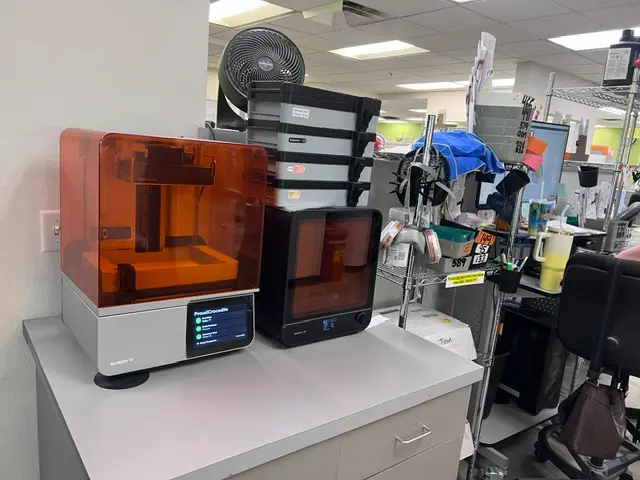
"I was blown away by how compact the printers were and how many fit on those industrial racks. It really got me thinking."
Nu-Art had used a variety of other manufacturers' systems for years while continuing to evaluate alternatives. What caught Haeuser's attention on Form 4B was a set of details that only matter if you actually run printers all day: the resin mixer, the cost of consumables, and how parts come off the build platform.
"I've literally had bloody knuckles myself, just scraping and chiseling," he said. On the Flex Build Platform, parts release by flexing the plate.
Labor, Waste & Consumables: The Hidden Costs of Production
A printer’s true cost goes well beyond the price tag. Attentive lab owners track every cost center: hardware (bought or leased), resin, consumables like tanks and films, and the labor to operate and maintain the printer. Understanding your fixed and variable costs help lab owners stay profitable in today’s competitive markets.
As a full-service lab, Nu-Art prints a wide range of materials and multiple tooth shades, which means keeping many resin tanks in rotation.
“With other systems, you’re constantly cleaning tanks out because you can’t afford to stock enough of them. Formlabs tanks are affordable enough that we can keep one for each material. That’s where Formlabs has a real leg up.”
Form 4 Resin Tanks are also built to last. They’re rated for 75,000+ layers, roughly 150 L of resin on average, and labs can keep using them past their recommended lifetime. That’s up to 15x the rated life of Asiga’s largest 10L tray, which stops working once it reaches its limit, even when it’s still in good shape.
A Comparison of Formlabs Form 4B vs Asiga & Carbon
|
Formlabs Form 4B |
Asiga Pro 4K |
Carbon M2/M3 |
|
|
Printer Cost |
Starting at $7,699 (one-time purchase) |
From ~$24,999 (one-time purchase) |
Lease only: ~$50,000/year, 3-year minimum |
|
Material Compatibility |
Open System |
Open System |
Closed System |
|
Tank Price |
$119 |
$85 - $215 |
Each extra cassette: ~$5,000/year |
|
Tank Life |
150 Liters |
10 Liters |
Not published (refurbished by Carbon under subscription) |
|
Model Resin Cost |
$79–$99/L |
~$138–$165/L |
High. Not published; quote only. |
|
Part Removal |
Flex Build - Easy Removal |
Manual Removal |
Manual Removal |
|
Resin Handling |
Automatic Resin Dispensing and Mixing |
Manual Dispense and Mixing |
Manual Dispense and Mixing |
How Formlabs Became Nu-Art’s Post-Processing Standard
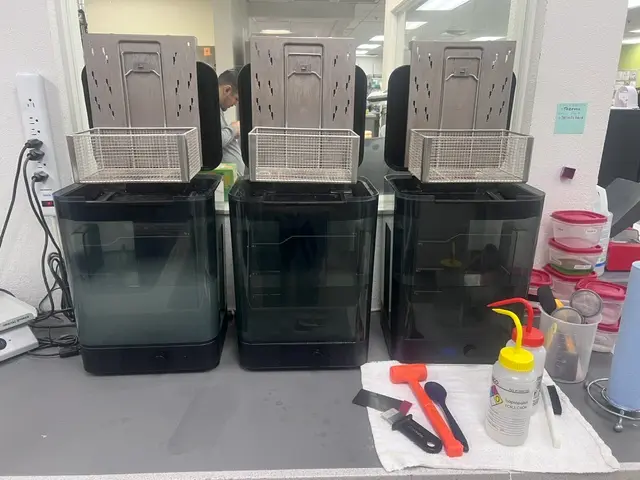
Nu-Art’s trust in the Formlabs ecosystem goes beyond printing. After many years of testing multiple competitor post-processing products, they chose Formlabs as their preferred cleaning and curing solution.
"Form Wash and Form Cure are our post-processing system of choice, not just for the Form 4B, but for every printer in our lab."
Nu-Art evaluated large industrial post-processing units sized to handle a full day of models in one batch. They chose the opposite approach: several smaller units, run in rotation.
The lab keeps a dirty wash, a medium wash, and a clean wash, and cycles parts through the three. That staging uses less IPA overall than one large-volume bath and keeps final rinses clean and effective. The automation is what makes it work unattended: the basket lifts itself out when the cycle ends. "You might walk away and leave something in there for a day sometimes, or overnight if you're not careful. And it's just super simple. We haven't had any issues with them at all."
Materials and Applications: Built for Craftsmanship
Nu-Art acquired and piloted their first Form 4B, testing its reliability across a wide range of applications and Formlabs materials. At the time of the interview, the lab had seen zero print failures.
“What I really like about it is that we’ve had zero failures, that’s been really fantastic.”
Materials include:
-
Denture Base Resin: For sizable denture base projects, with the newest Denture Base V2 Resin next on the lab’s list to test.
-
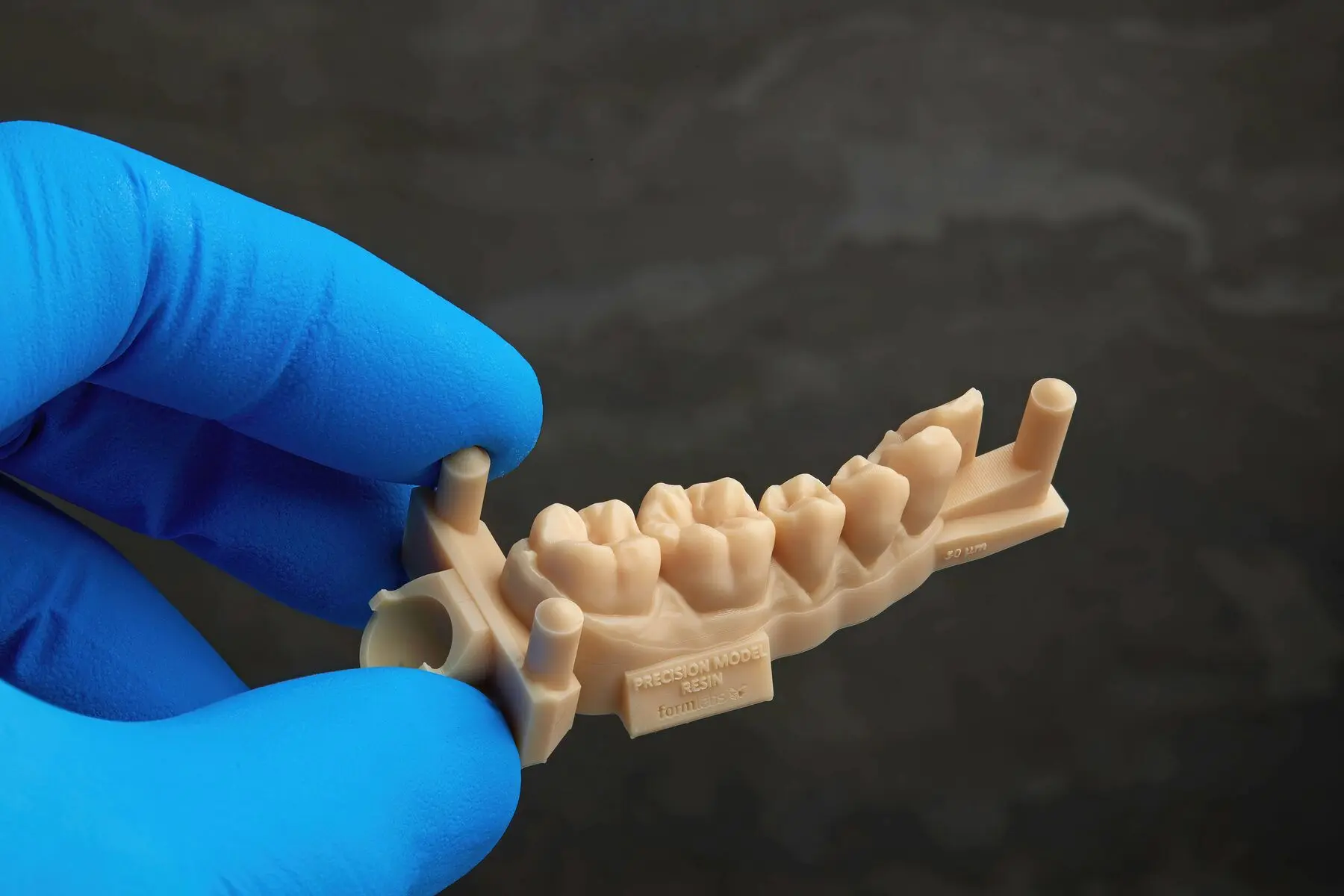
Precision Model Resin: For detailed restorative models and diagnostic models that guide treatment planning.
-
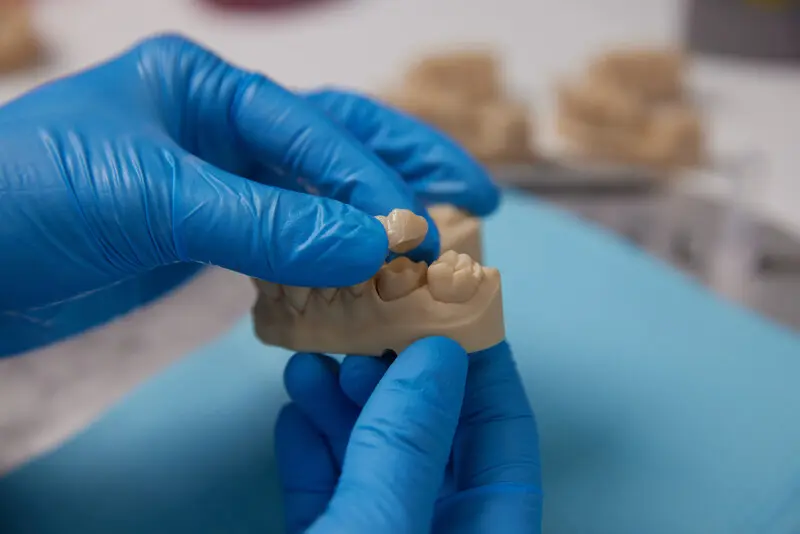
Castable Wax Resin: For highly accurate patterns for casting and pressing, replacing many patterns Nu-Art previously milled.
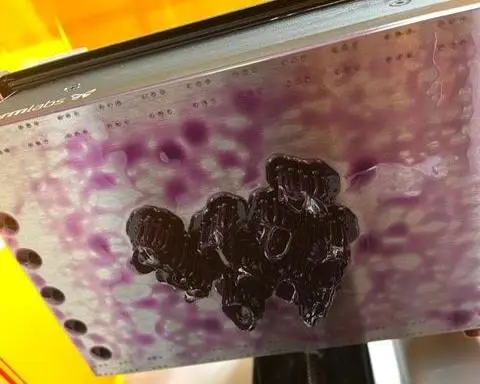
Castable Wax printed on Form 4B
Castable Wax Resin has become one of Nu-Art’s main Formlabs applications. Every pattern is fit-checked before it’s cast or pressed, and printing has outperformed milling. “With milling, there’s always a little bit of drill compensation or gap. We don’t see that with printing,” Haeuser said. “It’s a lot closer to what we’re accustomed to getting by hand.” The largest casting Nu-Art has ever produced came from a printed pattern.
Request a Free Sample Part
See and feel Formlabs quality firsthand. We’ll ship a free 3D printed sample part printed on the Form 4B to your office.
The Bigger Picture: Better Care, Stronger ROI, More Room for Artistry
For Haeuser, 3D printing helps everyone involved in a case. Patients can “test drive” complex treatments before the final, checking fit, function, and shade. Technicians spend less time on hand waxing and more on the details that become Nu-Art’s signature. And at a time when more technicians are retiring than entering the field, labs can take on more complex cases with fewer remakes.
Formlabs supports each piece. The Form 4B had zero print failures at the time of the interview. Training on PreForm took minutes, and Dashboard lets the team monitor builds from anywhere in the building. PreForm’s auto-nesting comes at no extra cost, a contrast with the paid software subscriptions some industrial systems require for file prep and nesting. “The fact that you guys don’t charge a recurring fee for that, that’s super duper attractive to me,” Haeuser said. Add in affordable tanks and Form Wash and Form Cure across the whole fleet, and the savings build up quickly. Next, Haeuser wants to scale up: “I could picture a rack full of these things automatically grabbing the files and really saving us time.”
“We have all the tools. We’ve tested it. We’ve used it. We believe in it.”